
By training, I’m an applied mathematician. I select an interesting aspect of the world, abstract away all the details, and create a mathematical model that (hopefully) provides utility to me and others. That aspect might be traffic in the street, or it might be quantum physics.
This essay is about my journey applying mathematics to quantum physics and what it taught me about the power, and the peril, of shared belief in science. It’s about how cultures form around ideas, how they guard their borders, and how a concept like “quantum computer" can mean radically different things to different people — and still be called the same name.
But most of all, it’s about what it means to be an outsider who stays — a stranger.
The stranger in physics town
Sociologist Georg Simmel once described a curious figure in group dynamics: the “stranger." Not a visitor or outsider, but someone who “comes today and stays tomorrow" — close enough to know the customs, distant enough never to fully belong.
That’s me. I’m a stranger in physics.
This distance didn’t make me superior. But it gave me perspective.
In physics lectures, I often heard the word intuition spoken with reverence — a sort of sixth sense for “what nature wants." I saw classmates light up when a professor referenced the historical arc of discovery or gestured with their hands to illustrate a concept as if it were self-evident. I felt like a tourist watching a religion in practice.
In applied math, “intuition" meant something else — a hunch, a sketch, a maybe. What mattered was rigor: formal definitions, precise proofs, logical steps. In physics, “intuition" was a form of arrival. If you got it, you were in. If you didn’t, no amount of technical proficiency could save you from that quiet, social exclusion.
Wittgenstein would call this a language-game: words whose meaning lives not in definitions, but in how they’re used. I could speak the syntax, but not the idiom. I was a fluent foreigner.
Close encounters with the physics kind
This feeling sharpened in graduate school, where the social structures of the discipline came into stark relief. I witnessed a culture of hero-worship that felt deeply unscientific. Esteemed professors would offer cryptic pronouncements, fragments of "wisdom" that were accepted by students with a reverence that bordered on cultish.
In one episode, I attended a research group meeting where postdoctoral students and graduate students struggled with designing and modeling an experiment. The rarely seen professor stepped in, listened for a few moments, and then evasively pronounced, “You have to go back to the physics."
To my surprise, this resonated with the collective mood, which seemed to value gnomic, profound-sounding insights that hint at a deeper, ineffable understanding rather than actual solutions. Indeed, the eventual solution had something to do with physics… how ever did he know?\!
At conferences, I witnessed a similar dynamic of hero worship. During one break, a renowned physicist was surrounded by eager students hanging on his every word. When asked which interpretation of quantum physics he favored, the physicist began with a nod to humility—saying none of them were quite right—before confidently endorsing the transactional interpretation, a fringe theory in which effects are their own causes. The crowd nodded along. I walked away.
On several occasions, as a young postdoctoral researcher, I was the sole voice that challenged the received wisdom. A particularly vivid episode was an encounter with Yakir Aharonov, who responded to a logical critique with poorly drawn diagrams and philosophical commentary. The expectation was a formal argument, but the response was a performance, a move within a different language-game that prioritizes Delphic wisdom and reinforces the hierarchical structure of the collective.
For the initiated, this performance was likely seen as a successful and insightful contribution. For the stranger, whose thought style demands a different kind of answer, it was an evasion. Looking back with the benefit of hindsight, the frustration stemmed from a failure to recognize that two entirely different games were being played. I didn’t realize I was a stranger.
Daddy, how are quokkas made?
For many years after that, I had a heavier foot outside of physics, which reinforced my stranger status.
For one, Australia is isolated from the physics community, and this isolation was compounded during and after the COVID-19 pandemic and lockdowns. At the same time, I landed in a computer science department where local responsibilities didn’t overlap with physics.
A defining challenge in my career came in 2020, when I was tasked with teaching Introduction to Quantum Computing to second-year undergraduate computer science students.
It had been over a decade since I was a student in a course by the same name, delivered by Richard Cleve at the Institute for Quantum Computing in 2006\. I still had the lecture notes, but there was a critical problem — Richard’s course was for physics graduate students. The content was useless. My students had no knowledge of science, let alone physics\!
One expectation of computer science students is that the code they write will run faithfully on a machine. Otherwise, what’s the point of learning it?\! Since no such device exists, my colleague Simon Devitt and I created one.
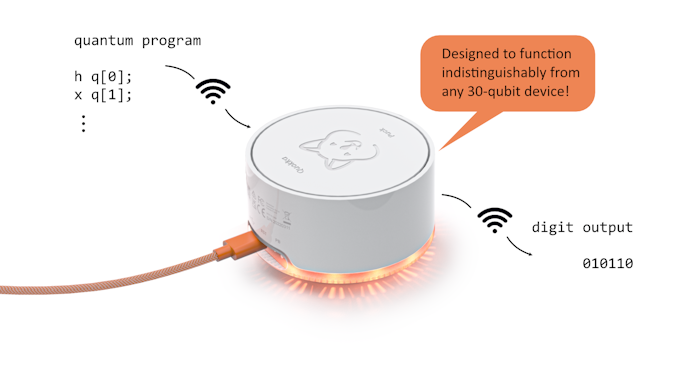
Quokka is a device that operates indistinguishably from an ideal (albeit small-scale) quantum computer. To make a long story short, it works — students are far more engaged while absorbing and retaining quantum concepts at a much faster rate than any other pedagogical approach.
Naturally, it was time to bring Quokka to the masses.
However, instead of the community celebration I had hoped for, bringing Quokka into the public sphere provided a quintessential case study in the sociology of physics.
Guarding the gates of physics
On various occasions, I’ve posted online stories, links, and memes about Quokka, referring to it as a “quantum computer you can program today."
The reaction from many in the (online) physics community was not about the emulator's utility or its correctness as a simulation, but about protecting the definition of what constituted a "real" quantum computer. This is a social process of defending intellectual territory, a process the sociologist Thomas F. Gieryn has termed "boundary-work."
Boundary-work is the rhetorical effort by which group members distinguish their work from outsiders to secure intellectual authority and resources. This dynamic played out for me in a raw, unfiltered way both last year on Twitter/X and more recently on BlueSky.
Each interaction began with the charge that Quokka is not a “real" quantum computer. When I pressed them to define the term “quantum computer," most physicists replied with the claim that a quantum computer is a physical machine that can execute quantum algorithms with at most polynomial resource scaling. Some demanded it use physical superposition and entanglement. Many couldn’t seem to answer at all.
However, these definitions were not offered in the spirit of clarification; they were used as weapons of exclusion. The criteria of "scalability" and "physicality" were strategically chosen because they are the prized goals of the experimental physics research program—and are, by definition, irrelevant to a pedagogical emulator.
When I pushed back, pointing out the irrelevance of their R\&D-focused definitions to my educational goals, the boundary-work escalated. The charge became "educational malpractice," an accusation that my work was not just "non-science," but actively harmful, perhaps even illegal\! This is the ultimate goal of aggressive boundary-work: to strip the stranger of their authority and police the in-group by casting the outsider's contribution as a threat.
In my language-game, I am using the term "quantum computer" where the primary goal is education and conceptual clarity. In this game, an object is a "quantum computer" if it allows a student to program one, to think with quantum principles, and to become engaged. The purpose is functional and pedagogical. My definition—A device that accepts and executes quantum programs demanding N qubits is an “N-qubit quantum computer"—is perfectly coherent within the rules of this game. The physical substrate is irrelevant.
Yes, Donkey Kong — but hear me out
Let’s warm up with a fascinating parallel found in a discussion thread on the Donkey Kong Forum. Here, enthusiasts passionately debate the accuracy of the emulated version of the original Donkey Kong arcade game that appears as a mini-game within the Nintendo 64 title Donkey Kong 64\. (For non-gamers, they are discussing the “realness" of a game that has been emulated on a system different from the original.)
In that thread, you’ll find meticulous analysis comparing subtle differences in barrel speed, the patterns of enemy AI, the fairness of collision detection, and the absence of the famous "kill screen" from the arcade original. They are deeply invested in whether the N64 version is a "faithful" or "accurate" simulation.
Back on BlueSky, not one person asked how accurate the emulator was or how engaged the students were. Instead, one said, “When I was a kid, I used to emulate a PS2 on my computer. Did I have a PS2? No I did not. An emulation is not the same as the thing itself." This was clearly meant as a fatal blow, an appeal to a common-sense distinction between reality and its imitation.
In this context, the most fascinating thing about the Donkey Kong conversation is what is not said. At no point does anyone interject to state the obvious: that the game on the N64 is not a literal, physical arcade cabinet from 1981. The "realness" they are concerned with is not about the physical object (the cabinet) but about the faithful reproduction of the system's behavior.
I could be generous and say their language-game is that of high-stakes, publicly funded, experimental research, where the term "quantum computer" is tied to a specific set of research goals and promises. However, these physicists, using the language-game of high-stakes research, are not just playing on their own field. They are attempting to impose their rules onto every other, declaring that no other game is valid.
Their reaction isn't just about protecting terminology; it's about policing reality itself. This obsession with labeling one version “real” and all others “fake” reveals a deeper anxiety, one that sociology alone can't fully explain. To grasp it, we must venture out of physics town.
The “desert of the real"
Philosopher Jean Baudrillard argued that our world is saturated with simulacra—copies without originals. We live in a "hyperreality," a condition in which simulations generate their own reality, independent of an origin.
While Baudrillard used his ideas to critique political ideology, it is no better exemplified than in physics, where the culture reinforces a firmly held and defended intersubjective reality. What starts simply as a shared agreement that something counts as “real" because enough people treat it that way gets absorbed into the broader physics hyperreality enforced by group dynamics.
Case in point: the physicist’s "real" quantum computer—the physical machine in the lab—is itself a simulacrum. It is a painstakingly constructed physical model designed to represent an abstract mathematical idea: a Quantum Turing Machine. Their vehement insistence on its exclusive "realness" is an attempt, in Baudrillard's terms, "of concealing the fact that the real is no longer real, and thus of saving the reality principle."
They must defend their physical model as "the real" to hide the fact that there is no single, ultimate, privileged physical referent for the term "quantum computer." The hyperreal is not a false representation of the real—it is a new real, a "realer than real" that precedes and effaces the original.
In their very attempt to be the ultimate realists—by demanding that all valid scientific concepts be grounded in a unique, tangible, physical substrate—the physicist engages in a profoundly postmodern act. They are elevating one particular simulacrum (their complex, lab-based machine) to the privileged status of "the real" and then using it as the benchmark against which all other simulacra (like the Quokka) are judged and found wanting.
They have, in effect, become the arbiters of the hyperreal, the gatekeepers who decide which simulations are granted the title of reality. This is the ultimate irony: their staunch defense of a fixed, objective "real" is the very behavior that Baudrillard identifies as characteristic of a world where the "real" has already vanished, replaced by a circulating, self-referential system of models.
Physicists believe they're merely observing and reporting on what they find in nature. In practice, they’re building and defending a shared framework for what constitutes nature. This is a fact of all scientific communities. But the danger comes when that framework becomes invisible — when consensus masquerades as objectivity.
The ultimate value of the stranger's interdisciplinary path lies in cultivating meta-awareness. It is the capacity to see the language-game from the outside, to recognize the thought style as a style, to understand the paradigm as a social construct, and to perceive the "real" as a simulation. This perspective is not a cynical rejection of physics, but rather a deeper and more nuanced understanding of how physics, as a human endeavor, actually operates.
Truth be told, I never stopped enjoying physics. But I stopped needing to belong to its tribe. I now see myself as a translator between disciplines. That perspective — the view, not from above, but from the boundary — has become my most valuable tool. It helps me teach, build, and question. It lets me stay intellectually honest.
And sometimes, it forces me to ask the one question that still stops the room: What do you mean by “real"?