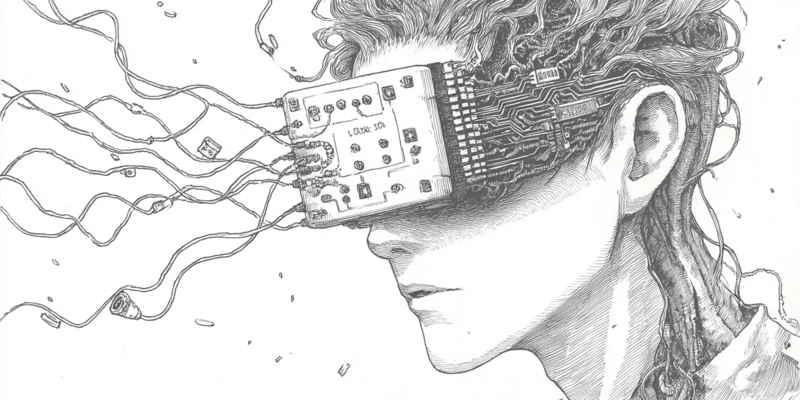
Attention Conservation Notice. It’s rant time. You see, back in the 20th century, we were taught to build our identities by choosing things—our possessions, our clothes, our brands. These weren’t just products but declarations of selfhood. But in the 21st century, algorithms don’t just observe those choices—they make them. What once felt like expression is now prediction. What once was owned is now assigned. And we’re still calling it “me.”
I saw a sign for a garage sale today and thought, they still have those?
Seriously. In an age where my phone knows I need more almond milk before I do, a garage sale feels like discovering a tribe still using MySpace. It’s a quaint, almost rebellious act of curating one’s own junk, a physical declaration of "I once chose this, and now, by the power vested in me by this faded card table, I un-choose it\!"
It got me thinking. We used to hunt for things. Now, things hunt us.
The "invisible hand" of the market? Please. It’s been replaced by the all-too-visible, hyper-personalized, eerily prescient digital hand of The Algorithm. And it’s not just nudging us—it’s practically dictating the decor of our lives and, maybe, the very essence of who we think we are.
Phone, my puppet master
Back in the 20th century, the golden age of advertising told us identity was something you constructed through consumption. Enter the Marlboro Man, the Bonneville convertible, the idea that a fridge could symbolize suburban success. Brands didn’t just sell function—they sold aspiration. But it was still your choice to buy it.
You think you decide what you want? That’s adorable. You probably also think reality TV is unscripted. The truth is, you no longer search for something you already desire. You pick up your phone, and it subtly, or not so subtly, tells you what you wanted all along.
It’s called hyper-personalization, a charmingly sterile term for AI sifting through your digital dandruff—every click, every doomscroll, every "like," every map query for "closest 24-hour taco place"—to build a profile with 5,000+ trackable data points. (Predictive models rarely need a fraction of it to peg your next impulse, by the way.) According to corporate filings, Facebook claims a 32% lift in conversion for shops that feed it full behavioural data.
These systems aren't just responding to your desires. They're architecting them, anticipating needs you haven't even had the decency to invent yet. One study showed AI can improve demand forecasting accuracy by up to 50% – which is boardroom jargon for "we know what you'll buy before you do, sucker."
My phone recently suggested I might enjoy a subscription box for "artisanal, small-batch, gluten-free dog biscuits." I’m more of a "it’s just a dog" kind of person. Yet, for a terrifying second, I actually considered it. "Maybe dogs are people now?" I mused. The algorithm almost had me.
Consumer agency used to be a performance. Now it’s just a behavioral dataset in a quarterly earnings report.
Your turn: Scrutinize your last three "impulse buys." Who was really pulling the strings—you, or the ghost in the machine?
Amazon cart, my (algorithmic) self
William James said our "self" is basically the sum total of all we can call ours. If he were alive today, he’d probably add "...and 70% of that is now suggested by 'Customers Who Bought This Item Also Bought'."
Our physical world is increasingly just an elaborate print-out of our digital one. That trendy boucle armchair you "discovered"? Chances are, it was algorithmically surfaced after you idly browsed "cozy minimalist Scandinavian death-trap" on Pinterest for three hours.
The possessions in your home are less a curated museum of your unique soul and more like the physical residue of your data-self's journey through the algorithm's meticulously designed sales funnel. Your identity, expressed materially, is becoming an echo.
I’m pretty sure my smart fridge is silently judging my algorithmically-influenced choice of almond milk. It probably has access to my cholesterol data.
Your turn: Do a quick scan of your living room. How many items began their journey to your ownership as a targeted ad or a "you might also like"? No judgment, just... awareness.
How I learned to stop worrying and love algorithmic gaslighting
Psychologists talk about the "endowment effect"—we value stuff more just because it's ours. It’s like, this generic coffee mug is okay, but my generic coffee mug? A priceless artifact. AI has hacked this. It doesn't just make us value the objects. It makes us value the desires it cultivates within us.
The algorithm plants a seed. It waters it with targeted content, "influencer" posts, and suspiciously relevant articles. By the time you click "Add to Cart," it feels like your brilliant, organic idea. It’s like a digital Inception, but instead of planting an idea to topple a corporate empire, it’s to convince you that your life is meaningless without a voice-activated, Wi-Fi-enabled egg timer.
I now own three distinct devices for frothing milk. Three. The algorithm identified a "critical deficiency in my morning beverage preparation routine." And I bought it. Literally.
Your turn: Think of a recent purchase you were genuinely thrilled about. Can you trace the breadcrumbs back to the very first time you encountered the idea of that product? Was it... a suggestion?
Self-Discovery™: now with personalized ads\!
The grand journey of "finding yourself" used to involve things like questionable fashion choices in your twenties, a brief, regrettable foray into slam poetry, or maybe just staring moodily out of bus windows. Now, your "personal growth" is narrated by the algorithm. "Users who demonstrate an interest in existential angst also frequently purchase weighted blankets and online mindfulness courses\!"
The "self" isn't being lost, per se. It's just being... outsourced. It's less "I think, therefore I am," and more "The algorithm suggests items aligned with my inferred psychographic profile, therefore I consider adding them to my aspirational Pinterest board." We might still be unique snowflakes, but the pattern of our melt is increasingly being predicted and directed.
My targeted ads currently believe my "authentic self" is a person who desperately needs more sustainable athleisure wear, a subscription to a rare tea service, and a portable pizza oven. The terrifying part? It’s not entirely wrong. Which means the AI knows my latent desires better than my own mother.
This is fine. Everything is fine.
So, that garage sale sign…
It felt like a postcard from a forgotten country, a place where "stuff" was a consequence of willed decisions, not algorithmic destiny. Maybe those people, with their sun-faded board games and chipped mugs, are the real rebels, consciously curating their own obsolescence, making actual choices about what stays and what goes.
Meanwhile, I’m off to check if my smart toaster has finally achieved sentience and ordered that fair-trade bagel subscription it keeps hinting at. My "self," it seems, is a constantly evolving, AI-curated SaaS (Self-as-a-Service) platform, and I keep forgetting to read the terms and conditions before clicking "Agree."